People usually see the result: a sharp photo of a turbine blade, a smooth video of a coastline, a clean shot of a construction site. What they don’t see is everything that happens before the propellers start spinning.
Honestly? That part is just as important as the flying itself. Here’s how a working day starts for me – and why preparation is the reason I can bring both the drone and the data home safely.
It all starts with the morning toolbox talk
Every single morning begins the same way: a toolbox talk with the site manager. Before anyone touches any equipment, we sit down and go through the day together:
- The daily plan – what needs to be done, in which order, and by whom
- The flight plan – where I will fly, what I need to capture and how long it will take
- The weather – and not just “is it sunny or not”
- Any special circumstances on site that day
- The permissions we need to have in place
- SIMOPS – simultaneous operations, meaning every other activity going on around us at the same time
That last one is easy to underestimate. On a busy site there are cranes, vessels, technicians and other teams working in parallel. My drone has to fit into that picture without getting in anyone’s way – and without anyone getting in mine.
Weather is more than wind
When we talk about weather, I pay special attention to a few things:
- Wind strength – at ground level and at the height where I’ll actually be flying
- Waves – when I’m working offshore, the sea state decides a lot
- The Kp index – a measure of geomagnetic activity. Most people have never heard of it, but strong solar activity can disturb satellite positioning and the drone’s compass. For precise work close to a structure, that matters a lot.
A beautiful blue sky can still be a no-fly day. And a grey, cloudy morning can be perfect for inspection work. You only know if you check.
The pre-flight check
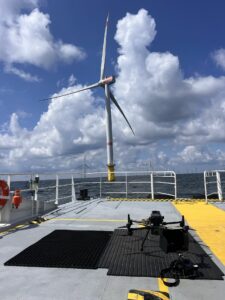
Before every take-off I do a full pre-flight check on the drone itself – frame, propellers, batteries, sensors, connections, firmware, the controller. It only takes a few minutes, but it’s the moment where small problems get caught on the deck instead of in the air.
From that moment on, I fly for as long as every safety factor is in place. If something changes – wind, visibility, the situation on site – the plan changes with it.
What’s always in my kit
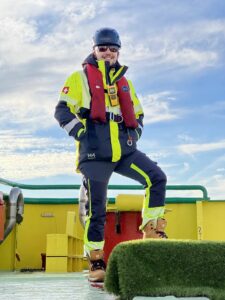
Apart from my PPE, there are a few things I will never start a job without:
- A screwdriver
- A soldering iron
- My troubleshooting kit
When you’re hours away from the harbour, there’s no shop around the corner. If a connector comes loose or something needs a quick fix, I want to be able to solve it right there – and keep the job going.
The day I didn’t take off
I’ll be honest: once we’ve sailed out, I always try to push to the limit to get the job done. Everyone on board has invested a long trip and an early morning into that day, and I don’t like going home empty-handed.
But there was one occasion I’ll never forget. Everything was ready, the drone was prepared, and then an unannounced aircraft appeared in the sky. It wasn’t in any of the information we had that morning.
I didn’t take off.
It was a simple decision, and it was the right one. By staying on the deck, we avoided any chance of a serious incident. The job could wait – a mid-air collision can’t be undone.
Pushing to the limit is part of the job. Knowing exactly where that limit is – that’s what makes a professional.
Why this matters to you as a client
When you book a drone pilot, you’re not only paying for the pictures. You’re trusting someone to work safely on your site, around your people and your assets. That trust is built in the hours nobody sees: the briefing, the checks, the kit, and the willingness to say “not now” when it counts.
That’s how I work on every job – whether it’s a family house, an industrial site or a turbine in the middle of the sea.
Have a project in mind? Get in touch and let’s plan your flight together.